
How Trust, Cultural Understanding and.......
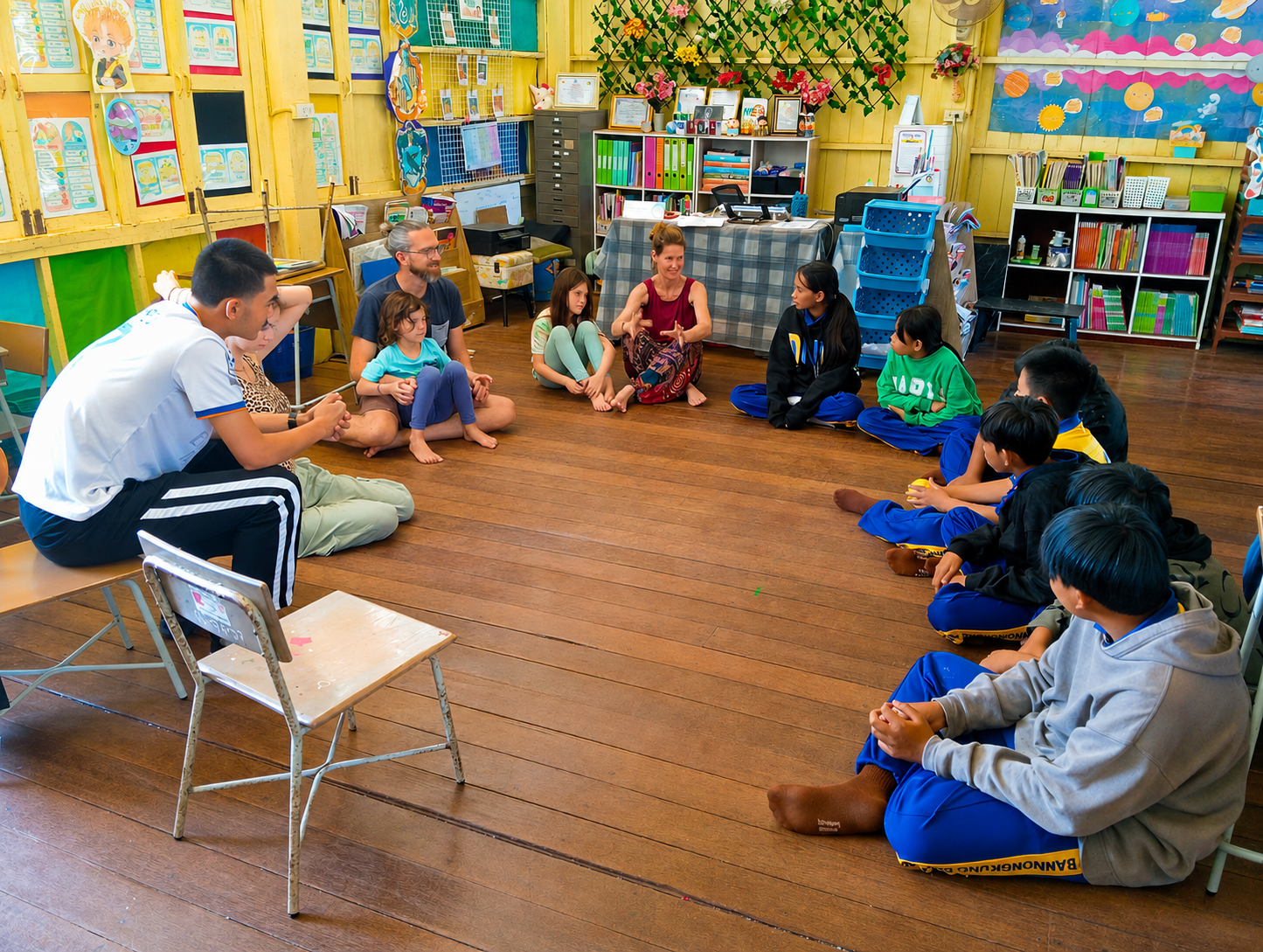
Anyone visiting a school with Volunt2Thai for the first time as a volunteer usually expects a normal English lesson.
However, within just a few minutes it becomes clear that much more is happening here than teaching vocabulary and grammar.
The lesson begins long before the first English word is spoken.
It begins with trust.
Since 2013, Raimund, Project Director of Volunt2Thai, has accompanied international volunteers to government schools in rural Northeastern Thailand. Over more than a decade, he has guided hundreds of volunteers from around the world through their very first day of teaching—university students, teaching interns, TEFL, TESOL and CELTA graduates, families with children, professionals on sabbatical, retirees, and people who simply want to make a meaningful contribution.
Many of them have never taught before.
They do not need to.
Because at Volunt2Thai, the goal is not to find perfect teachers.
It is to bring people together.
The international volunteers come to Thailand from many different backgrounds. Some are studying education or pedagogy and complete their international teaching placement with Volunt2Thai. Others already hold TEFL, TESOL or CELTA qualifications. Others are taking a sabbatical, have retired, or are travelling through Southeast Asia with their families.
Teaching experience is helpful, but not required.
The most important quality is the willingness to connect with children, to be creative, and to learn together with them.
Because language does not develop through classroom instruction alone.
It develops through human connection.
09:00 AM – On the Way to School
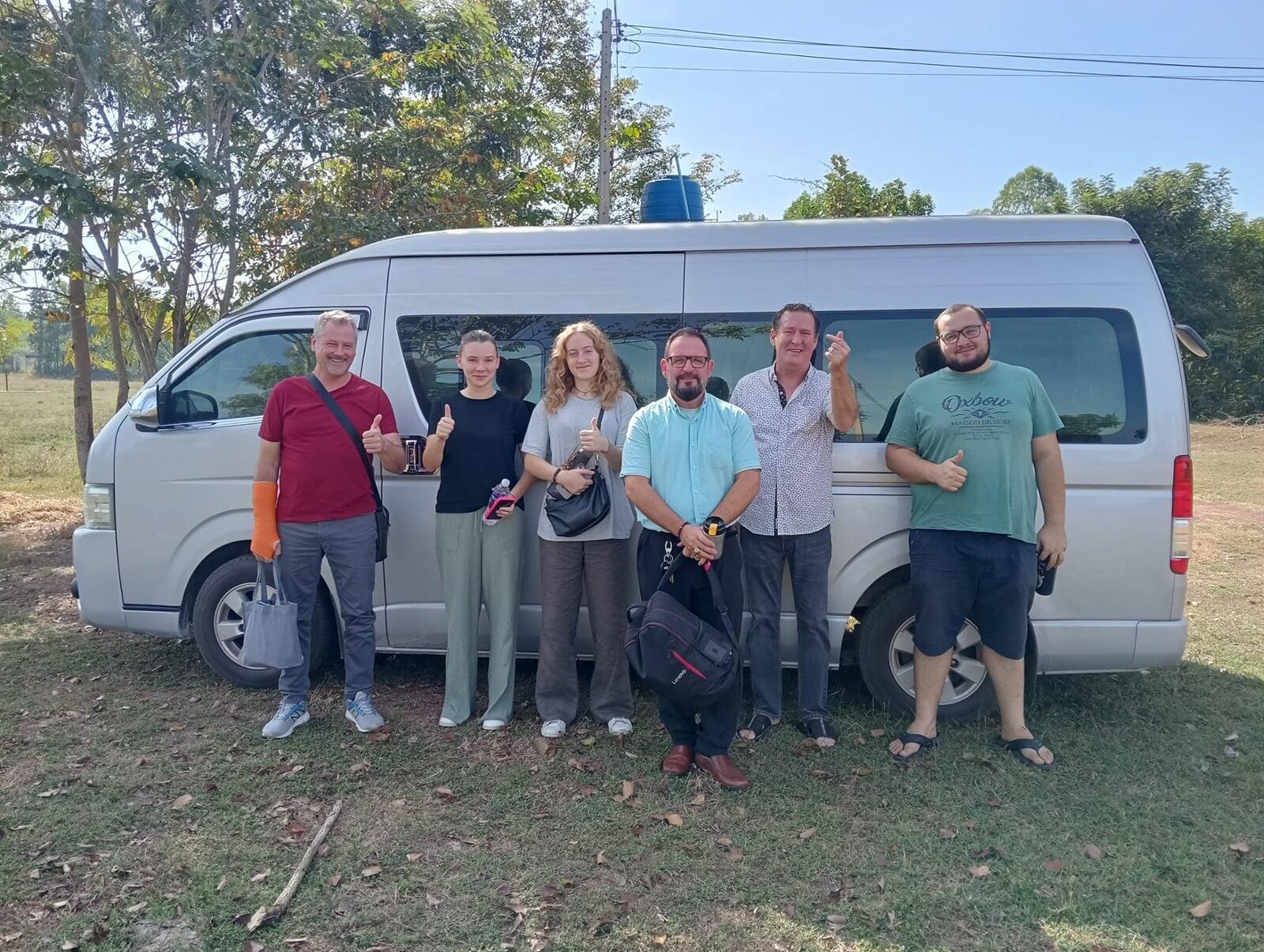
No two schools are the same.
Some classes have only six to twelve children.
Others have twenty or thirty.
Some schools have well-equipped classrooms.
Others consist of simple buildings or open multi-purpose halls.
Many schools are located far from larger towns and operate with very limited financial resources. Teaching materials are often scarce. Frequently, though not always, only a whiteboard, a few markers and some notebooks are available. English children's books, educational games and modern teaching resources are rarely found.
Especially the smaller village schools face another challenge.
Not every school has a qualified English teacher. Teachers often teach several different subjects and may themselves have only limited English proficiency. Some schools receive only a few hours of English instruction each week. In some smaller schools, there are times when no English teacher is available at all, requiring classes to be combined or supervised temporarily.
International volunteers do not replace these teachers.
They support them.
Lessons are prepared and conducted together with the Thai teachers. Both sides support one another.
Today, Volunt2Thai reaches more than 600 students every school semester across several partner schools. Depending on the school, teaching takes place in the morning, afternoon or throughout the entire school day, always in close cooperation with the local teachers.
The children are already waiting.
For many of them, today is something special.
Not because of the English lesson.
But because people from a completely different culture are coming to visit.
No School Day Is Ever the Same
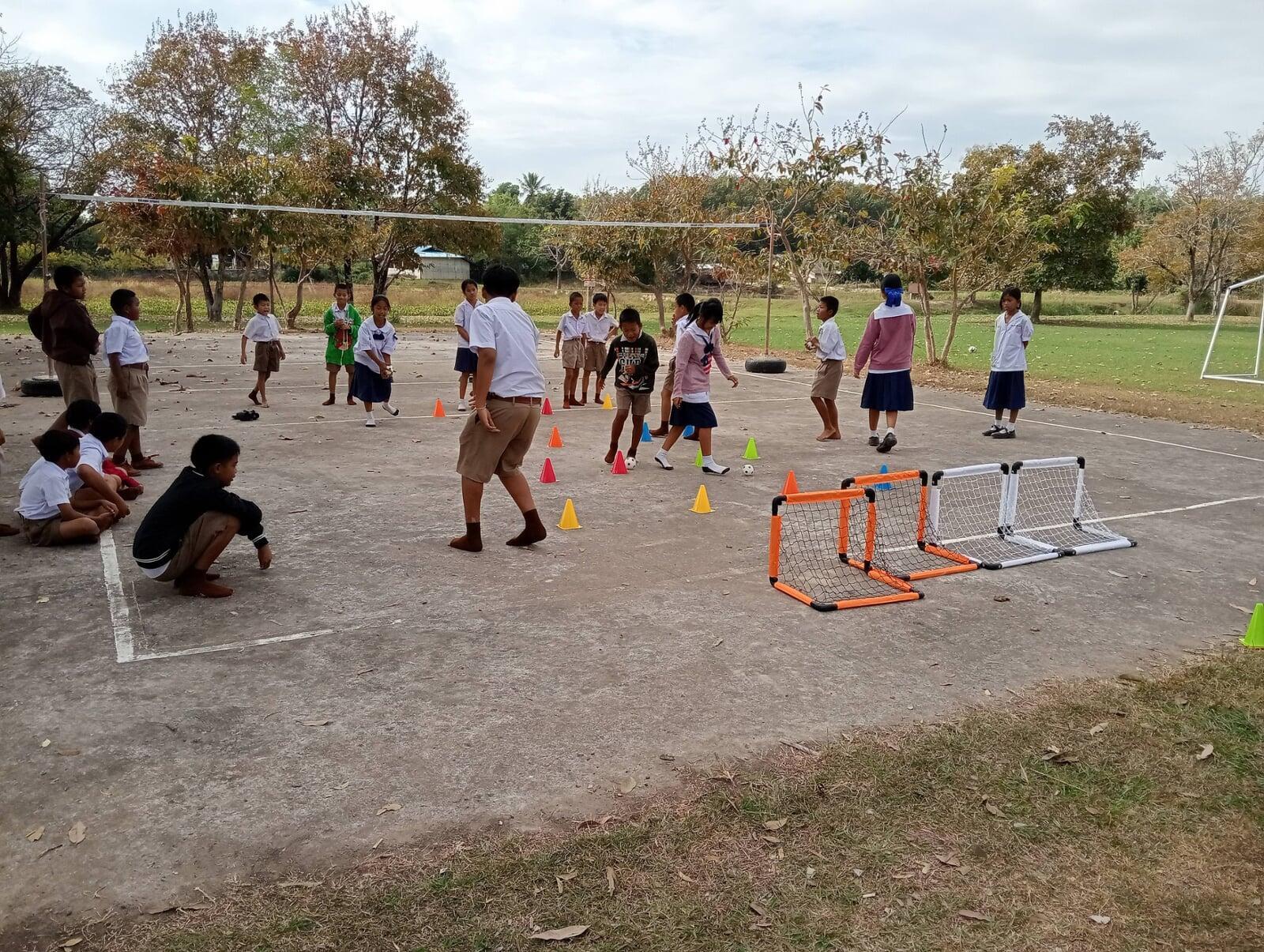
Even before the first lesson begins, nobody knows exactly how the day will unfold.
Perhaps today's class has only eight children.
Perhaps thirty students suddenly appear in the hall.
Perhaps several classes have been combined at short notice.
Perhaps a teacher is absent.
Perhaps the lesson has to be moved because of a school event.
That is exactly why Volunt2Thai does not work with rigid lesson plans.
Flexibility is part of the concept.
Every day, Raimund adapts the lesson to the situation, the children's age, their previous knowledge and the available resources.
Improvisation is not the exception.
It is part of everyday life.
This flexibility is exactly what makes the lessons so dynamic. An activity that works perfectly in one small class may have to be adapted instantly in another school. Sometimes only a blackboard and chalk are available; sometimes there are no teaching materials at all except the children themselves.
That is why movement, sports, music, role-playing, pictures, singing and sometimes even dancing play such an important role at Volunt2Thai. They work almost everywhere, regardless of the school's facilities.
09:30 AM – The Introduction
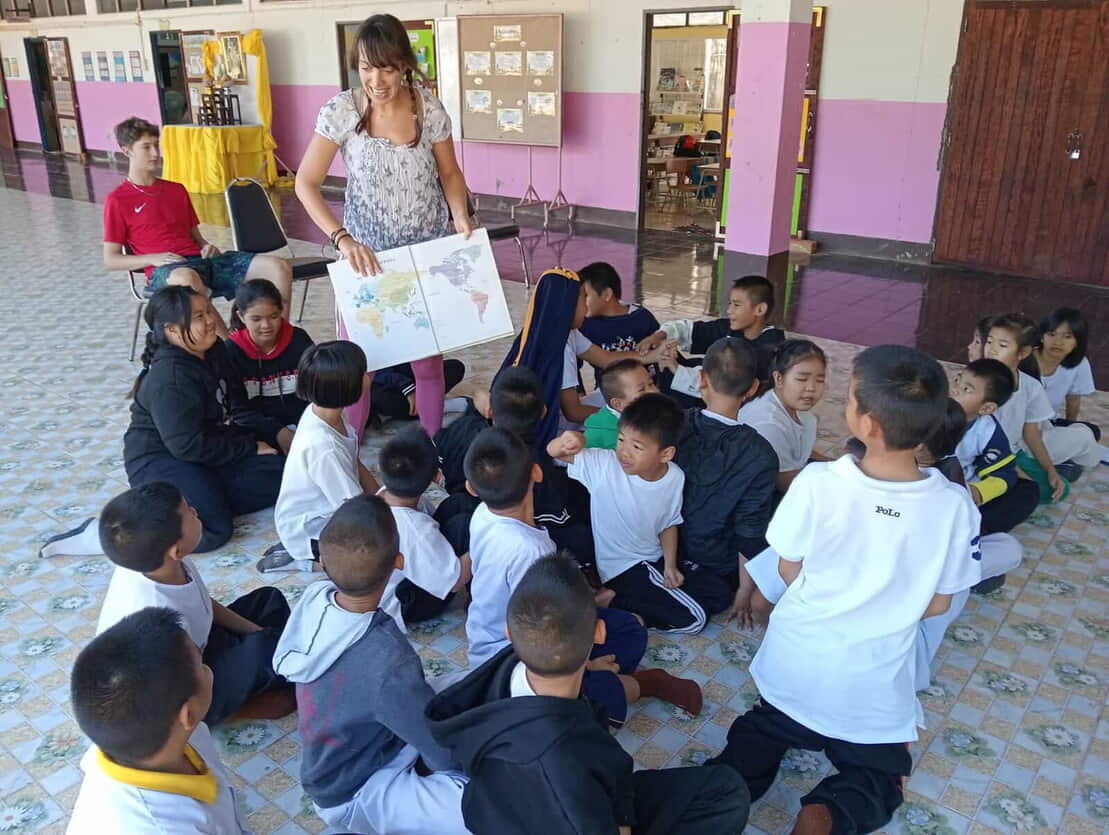
Before volunteers begin teaching, Raimund first prepares both sides for the encounter.
The children learn who is visiting today.
The volunteers become familiar with the school's particular environment.
Only then does the first introduction begin.
"Hello everyone. My name is Sarah. I come from Australia."
The children listen carefully.
Some smile.
Others look at each other with puzzled expressions.
Raimund watches their reactions.
"Who understood what Sarah just said?"
Some children recognise individual words.
Many still do not understand the overall meaning.
Now a single sentence in Thai is enough.
"Her name is Sarah and she comes from Australia."
Often, nothing more is needed.
Suddenly the atmosphere relaxes.
The children understand what is happening.
They listen attentively to the English again.
Why English Is So Difficult for Many Thai Children
Some people might ask why Raimund translates at all.
Shouldn't children hear as much English as possible?
The answer lies in the two languages themselves.
Thai and English belong to completely different language families.
They differ in writing, grammar, pronunciation and overall language structure.
Many English sounds simply do not exist in Thai.
Articles such as a, an and the do not exist.
Verb tenses work very differently.
In addition, Thai is a tonal language. Simply changing the tone of a word can completely change its meaning.
A Thai child is therefore not simply learning new vocabulary.
They are learning an entirely different way of understanding language.
When uncertainty appears, children focus first on one question:
"What am I supposed to do?"
At that moment, they are learning neither English nor the lesson itself.
A brief explanation in Thai removes exactly this uncertainty.
It does not replace English instruction.
It creates the conditions that allow English learning to begin.
Modern educational theory describes this principle as Scaffolding—carefully designed language support that helps learners understand new content until they can manage independently.
Raimund did not learn this from academic textbooks.
He discovered it through thousands of hours in real classrooms.
10:30 AM – Learning Begins with Joy

Now the volunteers take over.
They communicate.
They speak English.
They sing.
They play.
They draw.
They move together with the children.
Role-playing, movement games and music are part of almost every lesson.
Music, in particular, repeatedly proves to be remarkably effective. It also helps children understand that an English word keeps the same meaning regardless of the pitch in which it is spoken, unlike in Thai.
Many volunteers, as well as Raimund himself, describe how quickly children absorb English vocabulary when singing together and combining language with rhythm and movement.
Teaching materials are often created spontaneously.
A simple drawing of an apple on the board.
A ball.
A water bottle.
Or simply using their own hands.
Creativity replaces expensive materials.
Especially in schools with very limited resources, it becomes clear that excellent teaching does not depend on expensive equipment. A single ball, a few hand-drawn pictures or one shared song are often enough to create an engaging lesson.
Great teaching is not about perfection.
It is about enthusiasm.
11:00 AM – When Teaching Becomes Communication
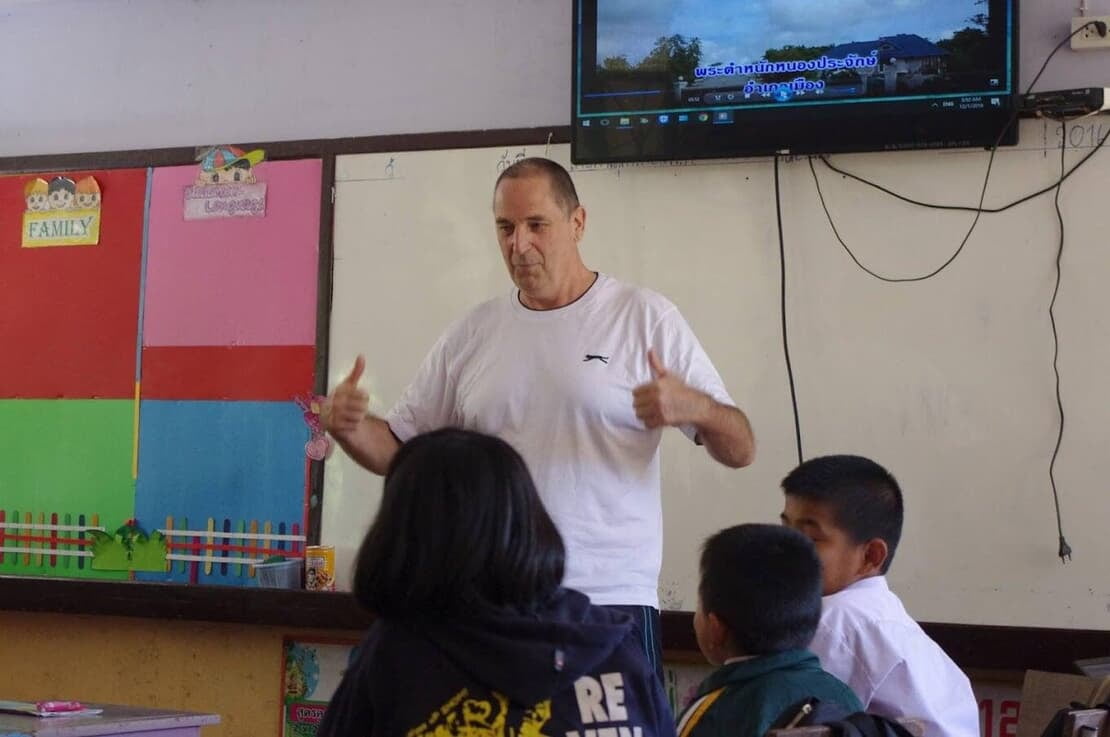
Minute by minute, the children become more confident.
They ask questions.
They laugh.
They point at objects.
They try out English words.
For the first time, they are not speaking for an examination.
They are speaking with a real person.
In many rural areas of Thailand, opportunities like this simply do not exist.
Outside school there are very few chances to use English.
At this moment, the lesson fundamentally changes.
English stops being a school subject.
It becomes a language.
At the same time, the volunteers begin learning their first Thai words.
They make mistakes too.
Both the children and the volunteers laugh together.
The children experience something very important.
They are not the only ones learning a foreign language.
Adults from Europe, Australia and America are also making an effort to speak Thai.
Teachers and learners become learning partners.
Many children experience for the very first time that English is not simply another school subject but a language that allows real conversations.
Obligation becomes curiosity.
Uncertainty becomes confidence.
More Than an Interpreter
The Thai language is important.
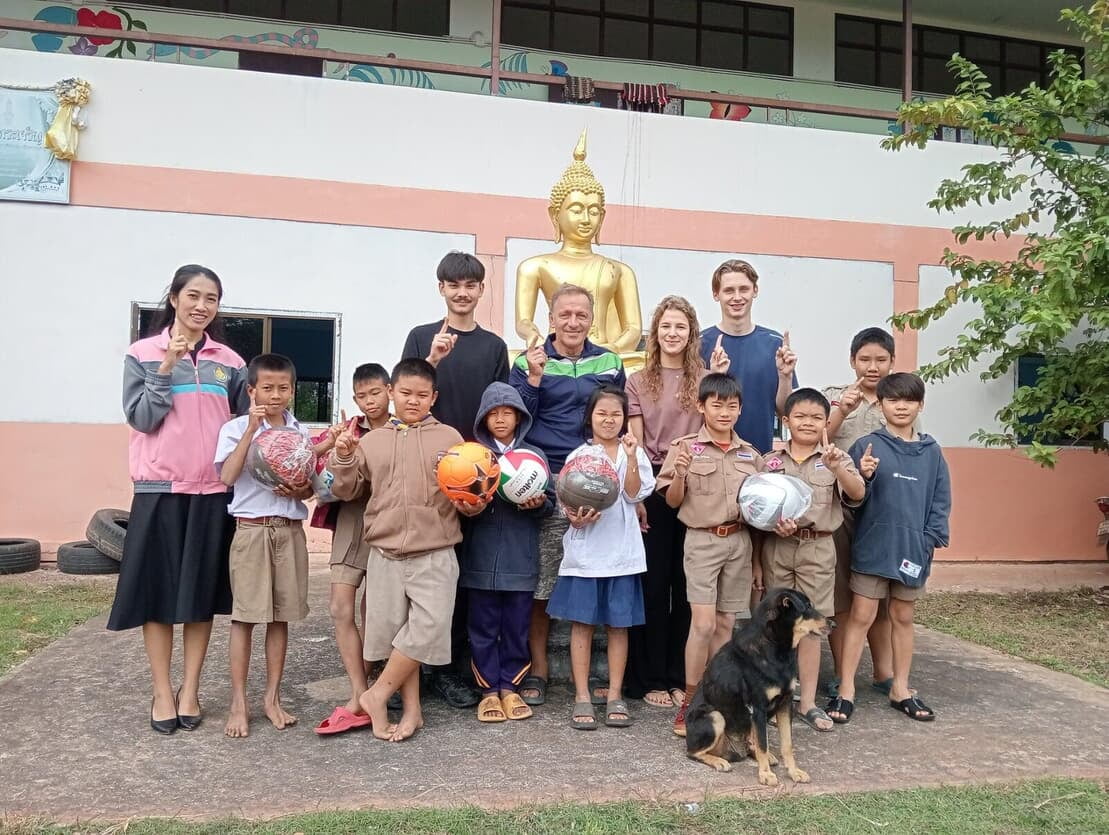
However, anyone observing Raimund during lessons quickly recognises that his role goes far beyond interpreting.
He connects cultures.
He explains expectations.
He recognises uncertainty.
He removes pressure from difficult and complex situations.
He builds trust.
This trust has grown over many years.
His own children attended—and still attend—the same government schools.
Teachers, principals, parents and many children have known him for years.
Raimund therefore does not arrive as a visitor.
He is part of the community.
That trust naturally extends to the volunteers.
The children open up.
They begin speaking.
Not because their English has suddenly become perfect.
But because they feel safe.
More Than Ten Years of Development
The development of the partner schools demonstrates how important continuous encounters really are.
When Volunt2Thai first began supporting schools in 2013, many children could neither fully recognise the English alphabet nor read simple English words. Some schools had no regular English lessons at all.
Today, new volunteers experience something very different.
Many children recognise both upper- and lower-case letters.
They can introduce themselves.
Hold simple conversations.
Name colours, animals, numbers and days of the week.
Of course, significant challenges remain.
Teaching materials are still limited.
Qualified teachers remain in short supply.
Not every school has a dedicated English teacher.
Yet one thing has changed significantly over the years.
The children's confidence.
And that is where every language truly begins.
This development is also reflected in the reports of numerous former volunteers. Year after year they consistently describe how children become increasingly willing to use English in everyday situations. The greatest progress is not perfection, but the willingness to speak at all.
A Bridge Between Two Worlds
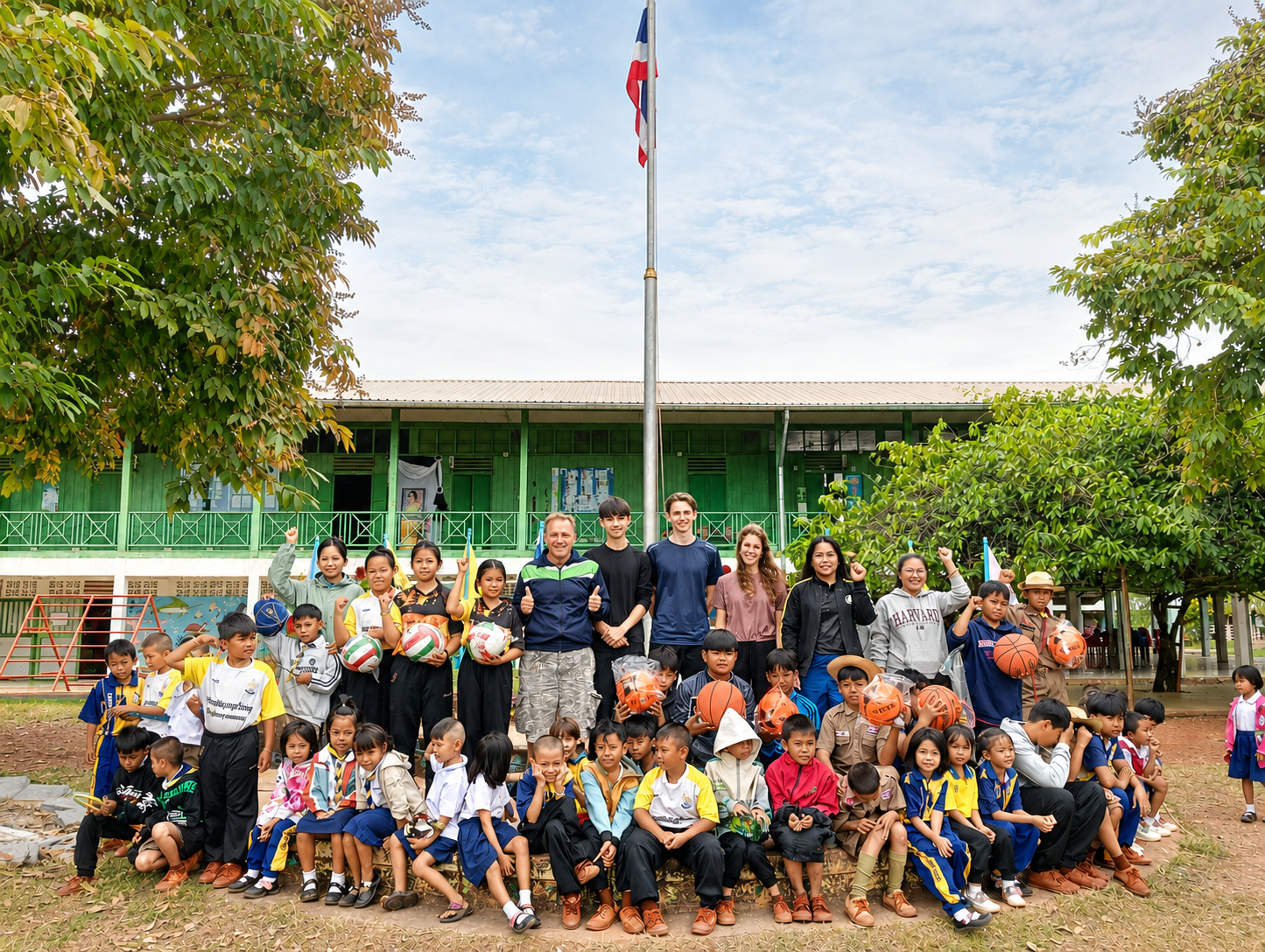
Volunt2Thai does not see international volunteers as replacements for Thai teachers.
They bring authentic English.
Intercultural knowledge.
New perspectives.
New cultures.
New friendships.
The children learn far more than language.
They learn about people.
They discover that mistakes are part of learning.
They realise that communication matters more than perfection.
Volunt2Thai sees education as a long-term process. Every volunteer may stay only a few weeks or months, but each one leaves something behind. Knowledge, encouragement and shared experiences remain with the children and are strengthened by every new generation of volunteers.
Over many years, this creates something that no single school day could ever achieve:
Sustainable learning through continuous human connection.
And when the lessons finish in the afternoon, many children run back one more time.
They wave.
They call across the schoolyard:
"Bye Teacher! See you next week!"
Only that morning, many had still been shy.
Some were afraid to speak English.
Now they say goodbye naturally.
Not because they suddenly speak perfect English.
But because they have found the courage to simply try.
And that has been the true goal of Volunt2Thai for more than ten years.
Language does not begin in textbooks.
It begins between people.